Demolition Contractor in Redding, CA

Plain notes on whole-house demolition in Redding, CA, from permits and utility disconnects to asbestos surveys, summer fire rules and debris haul off.

What We Cover

Demolition Contractor in Redding, CA

A whole-house teardown in Redding starts on paper, long before an excavator reaches the driveway. The parcel is looked up, the age of the house is checked, and the permit path is picked. Houses in Shasta County built before the early eighties carry the most questions, because their plaster, floor tile, roof felt and old paint can hold asbestos or lead.

What happens before a wall comes down

Every utility is shut off and capped first: power at the pole, gas at the meter, water at the main, and the sewer lateral or septic tank at the lot. Surveys for asbestos and lead paint go to a lab, and the results decide whether abatement happens ahead of the machines. Only then is the equipment unloaded, whether that is a full-size excavator, a skid steer or a mini excavator for tight yards near Palo Cedro.

How the structure comes apart

Roofing and decking go first, then the stud walls, then the load bearing walls and the framing around them. Drywall, plaster and lath are kept apart from clean lumber. A concrete slab and footing are broken last with a breaker or a jackhammer, and the foundation is pulled so the lot is flat and ready for a new build. Water runs through the whole job to hold the dust down.

Working around Redding weather and traffic

Summer heat and fire season push the workday to the early morning. Winter rain turns a bare lot to mud. Haul trucks route onto Interstate 5 away from the Sundial Bridge and the streets around the Cascade Theatre, and loads are sorted so concrete, metal, wood and roofing each reach the right yard.

Guides

The pages here cover permits for a teardown, utility disconnects, asbestos surveys on older houses, lead paint in the debris, summer heat and fire restrictions, and how the debris is sorted and hauled off. The posts add notes on neighborhoods near Shasta College and the shores of Whiskeytown Lake.

Latest Guides

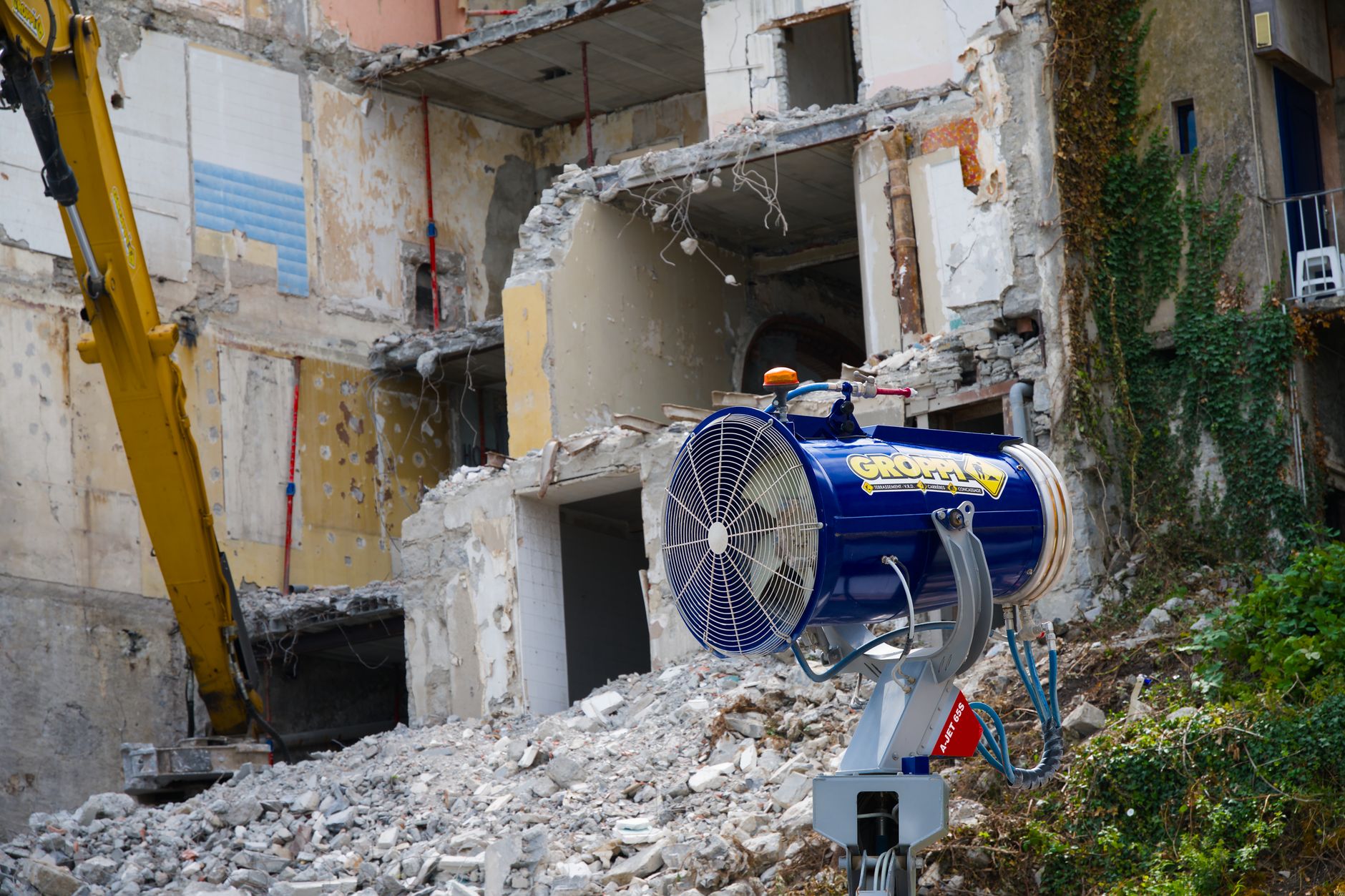
Industrial demolition with dust control machine and debris. Outdoors in daylight

How Long Does a Whole-House Teardown Take in Redding, Start to Finish?

2026-10-14

Most of a teardown's calendar is paperwork and waiting, and the machine time is the shortest part. A single story house in Redding can come down in two or three working days, yet the job as a whole usually runs several weeks before the first wall moves and a few days after the last truck leaves. Knowing where the weeks go makes it easier to plan a rebuild around Shasta County weather instead of against it.

Where does the time actually go on a Redding teardown?

The time goes to four places: surveys, notices, utility work and the permit itself. Each one has a waiting period built in, and several of them cannot start until another one finishes. The lab cannot test what nobody has sampled, the air district cannot be notified without a lab report, and the permit office will not issue a permit while a meter is still live.

The table below lays the phases out in the order they happen. The durations are typical ranges for an ordinary single story house on a flat lot, measured in working days or weeks, and they move with the season and with how old the house is.

PhaseWhat happensTypical length
Site walk and survey orderParcel, age, outbuildings, trees and access are checked; surveys are bookedTwo to four days
Asbestos and lead samplingSamples are cut on site and sent to a labOne to two weeks including the lab
Air district noticeNotice is filed with the lab report attached; a waiting period runsAbout two weeks
Utility disconnectsElectric, gas, water and sewer or septic are shut off and cappedOne to three weeks, in parallel
Permit reviewSite plan and releases are reviewed and the permit is issuedOne to three weeks
Abatement, if neededLicensed crew removes positive materialsTwo to six days
TeardownStructure is taken down and sortedTwo to four days
Foundation removalSlab and footing are broken and loadedOne to three days
Grading and final inspectionLot is leveled and signed offTwo to five days

What can the first two weeks tell you about the whole schedule?

The first two weeks tell you whether the house is clean or not. A survey that comes back negative for asbestos and lead keeps the job on the short path, and a positive result adds an abatement phase and its own notice. That one lab report is the largest single swing in the calendar, so it is worth ordering before anything else is booked.

Houses near Shasta College and along the older streets east of Interstate 5 tend to be on the long side of this table, because the housing there dates from the years when joint compound, floor tile and roofing felt routinely held asbestos. Newer tract homes in the outer neighborhoods often come back clean and skip the abatement step entirely.

Why do utility disconnects run in parallel with everything else?

Utility work runs in parallel because each provider keeps its own schedule and none of them answers to the demolition crew. The electric disconnect is booked with the utility, the gas cap with the gas company, and the water and sewer with whoever owns the main. Booking all four on the same day is how a job avoids losing a week to a single late truck.

A rural parcel near Palo Cedro adds a few extra items: a well pump on its own breaker, a propane tank that has to be pumped and hauled, and a septic tank that has to be pumped and either crushed or removed. None of those take long, but each needs a different company, so the booking calls start early.

How many days does the machinery really run?

The machinery runs for far fewer days than people expect. A full-size excavator with a thumb attachment can reduce a single story wood frame house to sorted piles in two days, and a skid steer works the piles into trucks alongside it. Work goes from the roof down: shingles and decking first, then the stud walls, then the load bearing walls and the rafters that rode on them.

  • Day one usually clears the roof, the ceiling and the exterior walls, with a water line running over the debris to hold dust down.
  • Day two takes the interior walls, the floor framing and anything left standing, and starts the haul off.
  • Day three, when needed, is for the detached garage, the porch or a chimney.

The foundation follows once the structure is gone. A breaker on the excavator splits the concrete slab into pieces small enough to load, and a jackhammer handles tight corners and the footing beside a retaining wall. Rebar is cut out and stacked for the scrap yard. A basement or a deep stem wall adds a day or two, since the void has to be filled and compacted in lifts.

Does Redding weather change the length of a teardown?

Weather changes the length more than the size of the house does. In summer, triple digit heat starts the workday at first light and ends the machine hours early in the afternoon, and fire season restrictions can pause any tool that throws sparks. A concrete saw or a torch on rebar waits until conditions allow, which can push the foundation phase a day or two.

In winter the problem flips. Rain turns the cleared lot to mud, trucks cannot get a clean exit, and the stormwater plan has to keep sediment out of the street. The best months for a teardown in Redding are the shoulder seasons, when the ground is firm and the air is cool enough for the crew to work a full day.

What happens after the last truck leaves?

After the last truck leaves, the lot still has to be graded, raked and inspected. The crew levels the pad, fills any open void in lifts, and pulls the erosion controls only after the inspector has looked at the ground. A final inspection closes the demolition permit, and an open permit blocks the next one on the same parcel.

Photographs and weight tickets go into the job file. They show which loads went to the recycler, which went to the landfill and which were handled as regulated waste, and a clean file is what lets a closing office or a lender see that the lot is ready.

How can a homeowner shorten the calendar without cutting corners?

A homeowner shortens the calendar by doing the front end early. Order the surveys the week the decision is made, clear out the contents of the house and the sheds before the crew arrives, mark the property corners and any buried lines, and book every utility on the same day. A house that is empty, surveyed and permitted when the equipment arrives is a house that comes down in days.

  • Order asbestos and lead surveys first, since the lab sets the earliest start.
  • Call every utility in one afternoon, not one a week.
  • Remove appliances, furniture and hazardous household items ahead of time.
  • Flag trees, fences and the septic lid so the operator knows what stays.
  • Pick a dry season window and work backward from it.

Skipping a step to save time is the only way to turn a few weeks into a few months. A stop work tag over an unfiled notice, or a cut gas line, costs more calendar than any survey ever did.

What does a good schedule look like in the end?

A good schedule starts with the lab and finishes with the inspector, and the machines fill the gap in the middle. Plan six to ten weeks door to door for an ordinary Redding house, add more when abatement or a septic system is involved, and count the dry months as the window that matters most.
Read more →

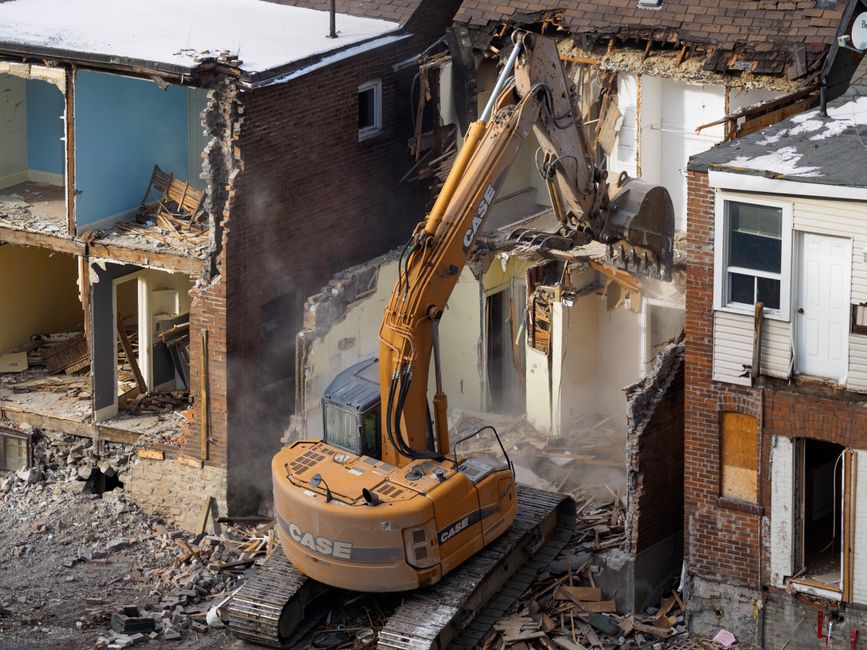
Powerful excavator tearing down an old house during a demolition project outdoors

What Stays and What Goes When an Old House Comes Down in Redding

2026-10-14

A teardown clears more than the house, and the questions that matter most are usually about everything around it. People ask what happens to the slab, whether the oak by the driveway survives, who handles the old septic tank, and what is buried in the yard that nobody remembers. The answers below come from the way whole-house teardowns are done on Redding lots, from older neighborhoods near Shasta College out to the acreage around Palo Cedro.

Is the foundation always removed with the house?

The foundation is removed unless the new plans reuse it, and that decision is written into the permit. A slab on grade is broken with a breaker on an excavator and loaded in pieces. A raised foundation has a perimeter footing and short stem walls, and those are pulled out the same way. Leaving a footing in place is allowed only when the new design says so, and the inspector marks it on the record.

Concrete is hauled clean to a recycler when it has no wood or dirt mixed in. Rebar is cut free and stacked for the scrap yard. A foundation that is full of dirt, trash or old asphalt tile gets sorted differently, so the crew keeps loads separate from the start.

What happens to trees and landscaping near the house?

Trees near the structure are flagged before the equipment arrives, and the ones that stay get a protection zone. An excavator swings a wide arc, and a boom that clips an oak limb can do damage that takes years to show. The root zone is the real concern: a heavy truck parked over it compacts the soil, so the haul route is planned to stay clear.

Some trees come out with the house, either because the new plans need the space or because they are too close to be saved. Large trees and oaks can be protected by local rules, so the question gets answered with the city or Shasta County before anyone cuts.

  • Mark the trees that must stay with tape or paint before the crew arrives.
  • Keep trucks and stockpiles outside the drip line.
  • Ask about permits for any large tree that is going.

Who deals with an old septic tank or a buried propane tank?

A licensed septic contractor pumps and decommissions the septic tank, not the demolition crew. The tank is pumped empty, then it is either crushed in place and filled with gravel or lifted out whole, and the leach field is left undisturbed so the lot can still be built on. The record of what was done goes to the county health office.

A buried propane tank is a different problem because nobody has to report one. Rural parcels often hold a tank that was installed decades ago and forgotten. The supplier pumps it out and hauls it, and the crew probes the yard with a rod before any digging starts. Finding one with a bucket tooth is a bad day for everybody.

Are fences, sheds and driveways part of the teardown?

Fences, sheds and driveways are in the job only if the permit and the contract name them. A detached garage and a covered patio count as structures and go on the permit sheet. A driveway can stay as a staging area and haul route, then come out last. A fence on the property line is usually left alone because it may belong to the neighbor.

A shared fence is worth a conversation before the work, since a boom reaching over it can pull posts loose. Many crews photograph the fence before and after, so there is a record of what condition it was in.

What is under the yard that might surprise the crew?

The yard hides more than most owners expect. Buried irrigation lines, old drain pipes, a dry well, a forgotten cistern, an abandoned fuel tank, a burn pit full of glass and metal. On older Redding lots the original house may have been replaced or added to more than once, and each version left something behind.

Calling the underground locating service before digging marks the public lines. Private lines, like the one running from the house to a detached shop, do not get marked, so the crew relies on probing, on old plans and on what the owner remembers. When something unexpected turns up, work stops at that spot until it is identified.

How is dust kept out of the neighborhood?

Dust is controlled with water, applied continuously from the first cut to the last load. A hose line or a misting cannon wets the structure before it is touched, and the operator sprays as each section drops. The water has to be arranged ahead of time through a hydrant meter or a tank on a trailer.

The dust plan matters most on old houses, where plaster, drywall and paint chips go airborne at the first impact. Wind off the hills near Whiskeytown Lake can shift a plume across a property line in a minute, and a gusty afternoon stops the work for the day. Neighbors are told the dates, and the crew keeps the street swept.

What happens to the debris once it leaves the lot?

The debris is sorted at the site and hauled in separate loads. Clean concrete goes to a crusher, metal goes to a scrap yard, clean wood goes to a chipper or a transfer station, and everything else goes to the landfill. Materials that tested positive for asbestos or lead paint follow their own handling and go only to facilities that accept them.

A single story house usually fills somewhere between eight and fifteen truck loads, depending on whether it has a slab, a crawlspace and a detached garage. Trucks are weighed going in, the tickets are kept, and the haul route stays off the downtown streets near the Cascade Theatre and the Sundial Bridge, using Interstate 5 to reach the transfer station instead.

What condition is the lot in when the job is done?

The lot is left graded, raked and clear of debris, with the erosion controls in place until the inspector releases them. Open voids from a basement, a pool or a septic tank are filled and compacted in lifts so the ground will carry a new foundation. A magnet sweep picks up nails and screws that would otherwise puncture tires.

Photographs, weight tickets, survey reports and the cap records for each utility go into the file. That file is what a builder, a lender or a title company asks for later.

Should a homeowner expect anything to be left that was not planned?

Something is almost always left that was not planned, and the best defense is a walkthrough with the foreman before the work starts. Walk the lot, point out every item that stays, and get the list written down. The common leftovers are a chimney base, a section of footing under a retaining wall, and a few feet of old pipe.

A short walkthrough at the end of the job catches the rest, before the equipment leaves the site.

Read more →